DELPHI Exchange: Oihana in Stralsund
A week of exchange, alignment, and first architectural decisions for PelAtlas under the EU-CONEXUS DELPHI project.
Oihana spent eight days with us in Stralsund as part of DELPHI, our EU-CONEXUS exchange project. We came in with a shared question: how can marine mammal photo-ID become more scalable without losing scientific traceability?
The week unfolded along three intertwined threads. First, a structured deep dive into her long-term research context and capture–recapture practice. Second, a reciprocal exchange on software engineering and machine learning concepts. And third, the joint design of the workflow and software platform we now call PelAtlas.
We did not leave with finished code. We left with a clearer structure: of the problem, of our respective roles, and of the system we want to build.
Arrival (with delay)
The visit almost did not begin as planned. Oihana was supposed to arrive on Monday, but snow and ice chaos across Germany disrupted train traffic nationwide. Between delayed platforms, unclear signage, and the additional challenge of navigating it all without speaking German, she ended up boarding the wrong train in Berlin — which took her to Hannover before she could turn around.
After another attempt that only reached Angermünde, and an unplanned overnight stay in Berlin, she finally arrived in Stralsund on Tuesday afternoon: 24 hours late and with a much longer journey than expected.
Tuesday was immediately absorbed by preparation. The following day, we were scheduled to present in Rostock.
Rostock: Positioning the Collaboration
On Wednesday, Oihana presented her research context and long-term photo-ID practice to colleagues at the University of Rostock. Additional guests joined online from the Marine Science Center and her NGO in France. Colleagues from the Thünen Institute for Baltic Sea Fisheries were present as well.
In a short joint slot, we outlined where our collaboration aims to intervene: not replacing ecological expertise, but structuring it into a scalable, technically coherent workflow. The core challenge is not classification accuracy in isolation. It is how to turn large volumes of heterogeneous survey imagery into reliable capture histories without overwhelming expert capacity.
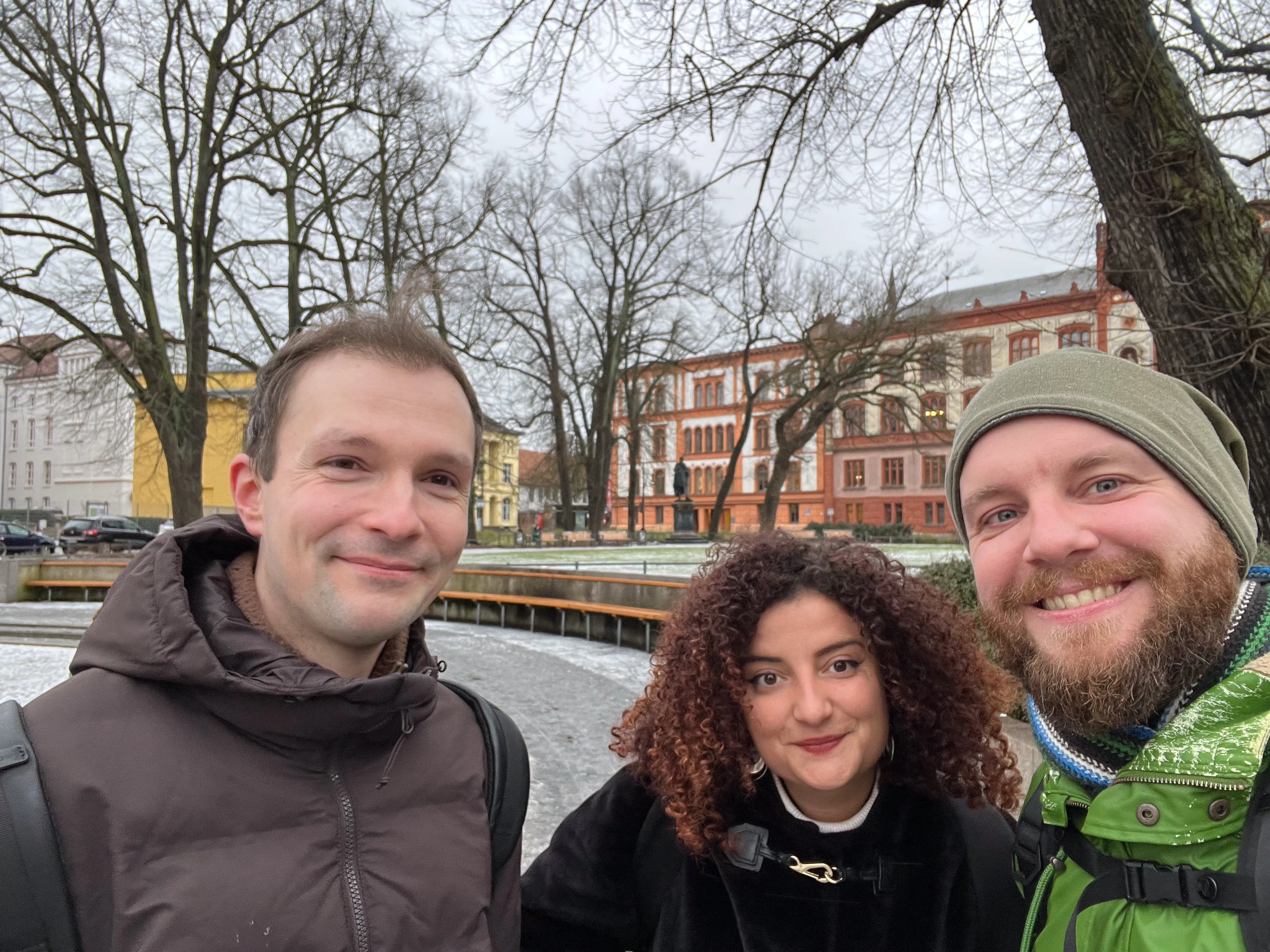
The afternoon discussion with my supervisors sharpened the stakes. A central question emerged:
Should we primarily aim to digitally support the existing citizen science workflow? Or should we design for a higher degree of automation from the outset, integrating experts (and potentially citizens) through active learning instead?
Whiteboard Decisions
On Thursday, back in Stralsund, we stepped away from incremental improvements and sketched our “ideal” workflow from scratch.
That whiteboard session was the turning point.
Both of us value citizen science, not as a buzzword, but as a meaningful way to foster ocean literacy and attentiveness toward marine ecosystems. At the same time, there is urgency in producing scientifically robust outputs that can inform policy decisions on vulnerable marine populations.
Those two impulses are not identical.
In that tension, we made a deliberate choice: the first iteration of PelAtlas will be designed as an expert-centered platform. Automation, open-set integrity, and traceable decision logging take priority. Citizen-facing components are not excluded, but they will be layered onto a system whose foundation is scientific robustness and scalability.
That decision clarified many downstream questions.
We framed the workflow in stages: presence filtering, region-level identity evidence, embeddings and within-sighting grouping, retrieval with explicit open-set handling, and expert verification.
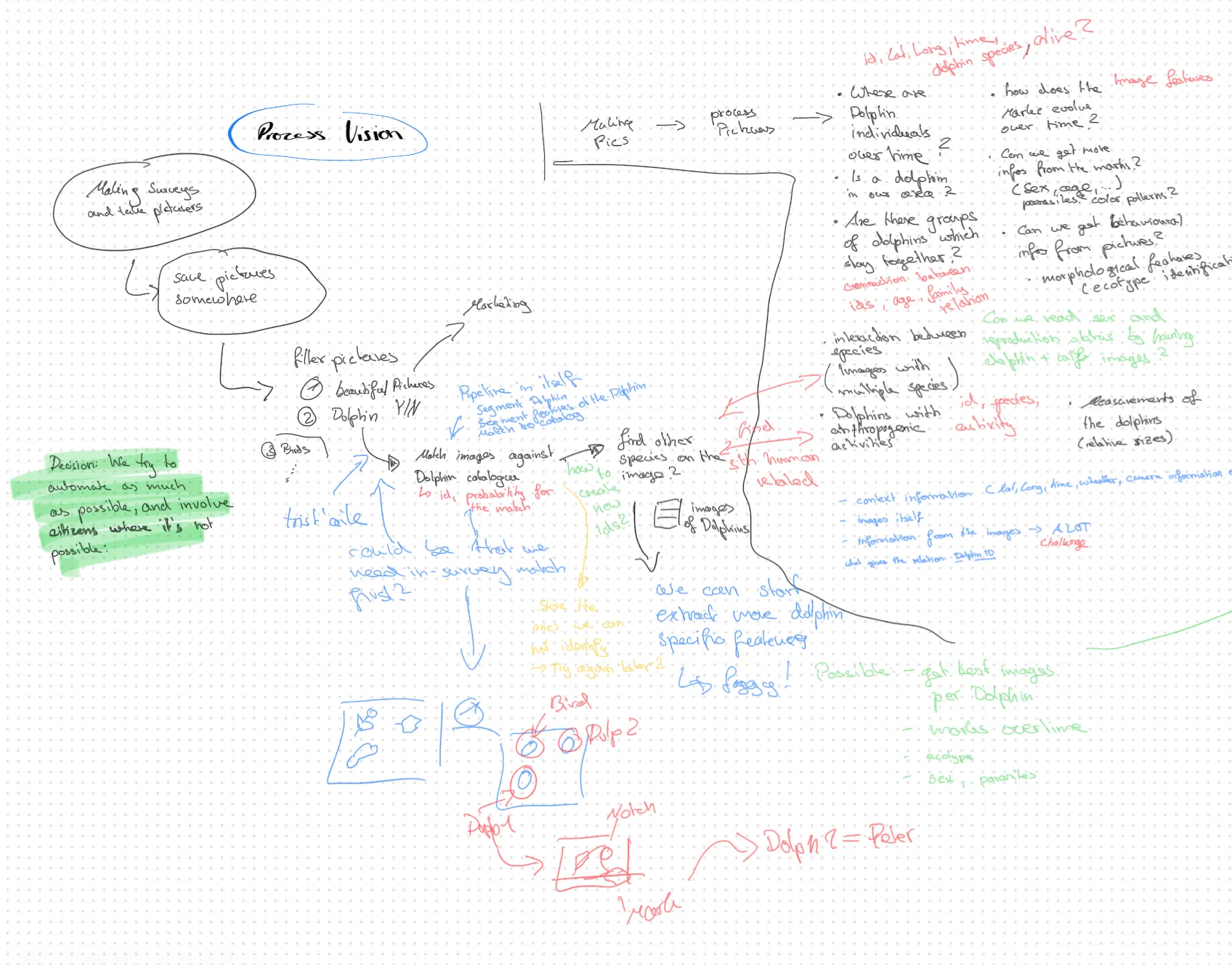
Traceability became a system requirement rather than an afterthought: for every verification decision, the evidence shown and the outcome must be reproducible.
None of this is visible as a feature yet. But it is visible as structure and structure is what makes the next year of work possible.
Establishing a Shared Technical Language
Friday shifted the focus again. We stepped back from architecture diagrams and discussed the fundamentals of web systems and machine learning workflows: how data moves through a platform, how asynchronous processing works, what “model versioning” practically means, and how embeddings become retrieval systems.
The goal was not to turn an ecologist into a developer. It was to ensure that future design decisions rest on shared conceptual ground. Interdisciplinary collaboration only works if both sides understand the constraints the other operates under.
Winter Interlude
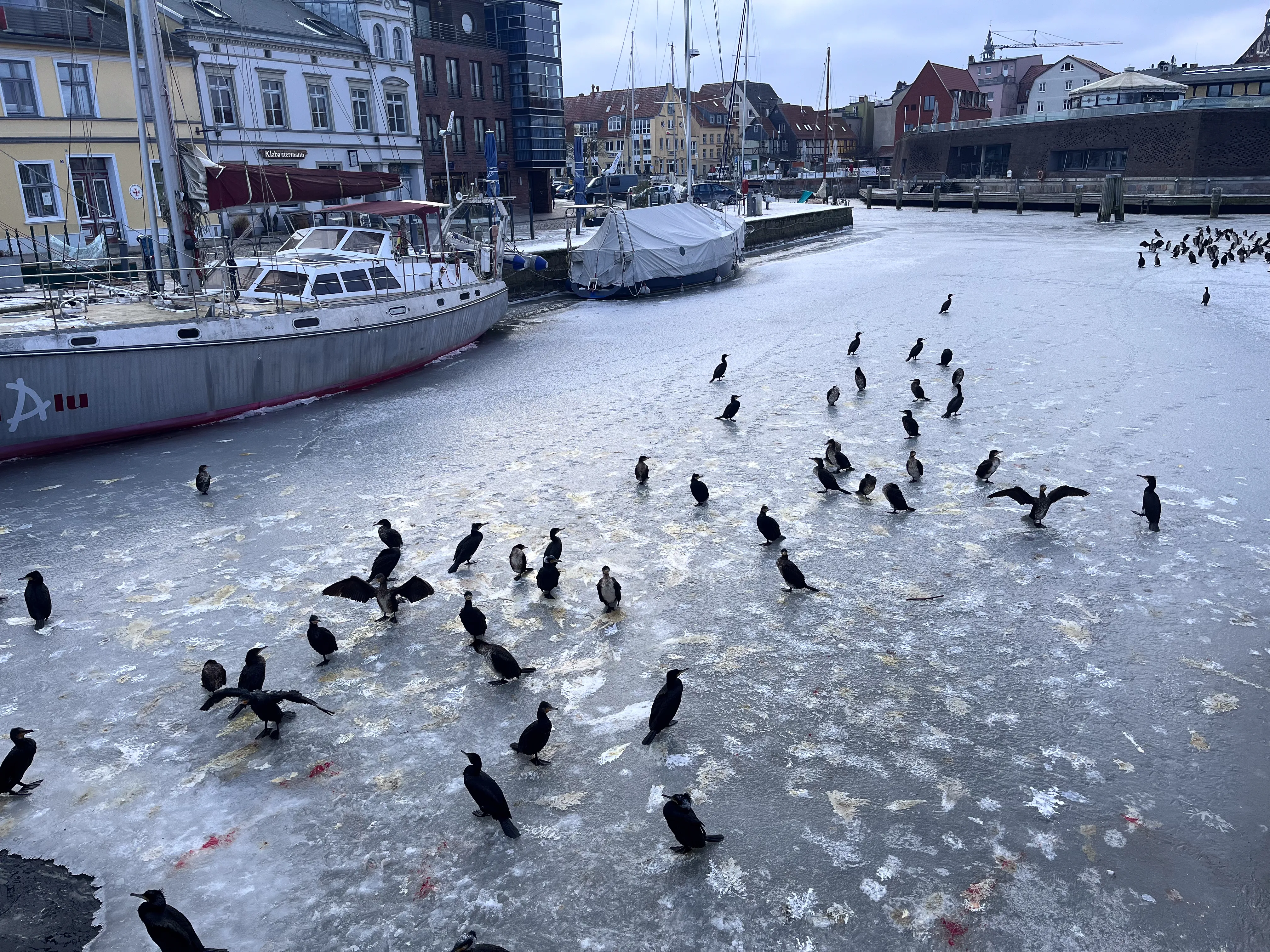
The weekend offered a different kind of contrast. Stralsund at –10°C, frozen waters, and long walks across icy surfaces are far removed from Brittany’s Atlantic coast. The environment was quiet, almost static, a useful counterpoint to the density of the previous days.
From Concepts to Next Steps
By Monday, the conversation had shifted from ideas to coordination.
We clarified stages and responsibilities, agreed on documentation tools, outlined data exchange formats, and defined how we want to structure collaboration going forward. We also began brainstorming directions for an abstract submission to the World Conference on Marine Biodiversity, with a mid-March deadline.
When Oihana left on Tuesday morning, we did not have a finished system. But we had alignment: on priorities, on architectural stance, and on the immediate next steps.
For DELPHI, the week fulfilled its purpose as an exchange. For PelAtlas, it marked the moment the project moved from an idea to a structured plan.
And for me, it was a reminder that progress in research does not always look like new features. Sometimes it looks like clarity.
Found this useful? Leave a signal.
Note on authorship: This text was developed with the support of AI tools, used for drafting and refinement. Responsibility for content, structure, and conclusions remains with the author.