Sie möchten die Seite auf Deutsch sehen? DE
Reflection deck
Offener Kreis
Guiding Questions for Thoughtful Participation
A question set for research coordination, project management and facilitation - to decide whether, where and how participation is sustainable.
Free physical copies available while the first edition lasts. Shipping costs may apply.
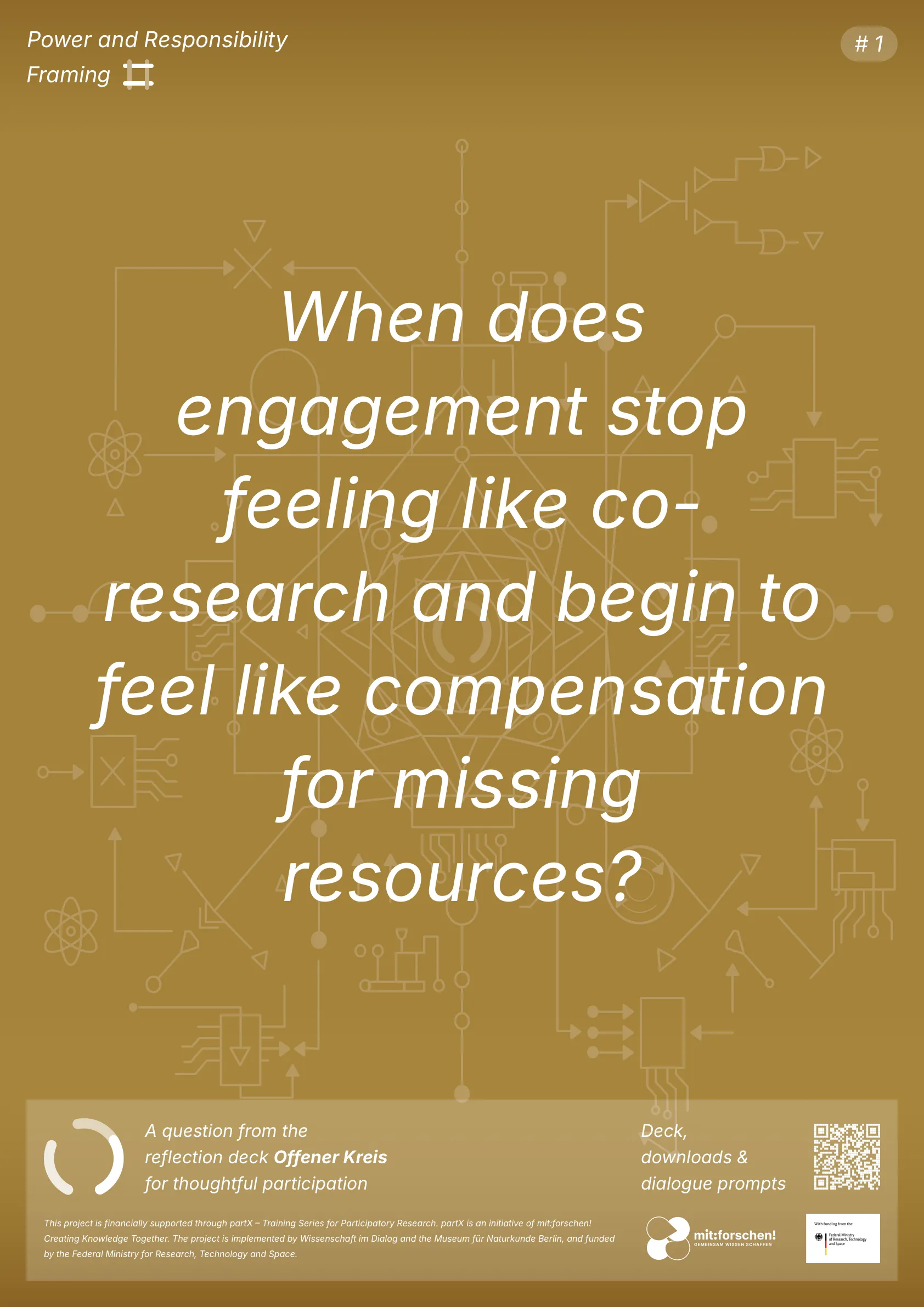
When does engagement stop feeling like co-research and begin to feel like compensation for missing resources?
1
Phase: Framing
Orientation: Power and Responsibility
How the deck works
The logic of the deck
Offener Kreis is a reflection deck for projects that want to shape participation consciously rather than merely promise it.
Two dimensions, one card
Every card combines one project phase with one orientation. Together, they show where you are in the process and what kind of tension the question helps you examine.
Project phases
The phases structure the typical course of a research project into clear stages. They help you see when a question becomes especially useful.
Orientations
The orientations reflect recurring tensions in participatory research. They show from which angle a question is asked and which dimension of the project it brings into focus.
Reading the example card
The example card above belongs to the Framing phase and the orientation Power and Responsibility.
Read cards this way: the phase tells you when the question matters most; the orientation tells you what kind of tension it helps surface.
Not a course, not a method, not a checklist - "consciously not" is also legitimate
The deck is not meant to maximize participation, but to make decisions more honest and easier to articulate.
Entry points
Three cards are enough
Choose 1 entry point. Take 3 cards. Optional: +1 contrast card.
Starting with an orientation
Power and Responsibility
Entry cards
Knowledge and Validity
Entry cards
Time and Commitment
Entry cards
Use and Impact
Entry cards
Language and Publicness
Entry cards
Optional: 1 contrast card from another orientation
Starting with a phase
Framing
Card range
Design
Card range
Collection
Card range
Interpreting
Card range
Sharing
Card range
Use cards especially when a decision point is approaching.
What you take from it
Per card: three brief notes
- What is this really about for us?
- What can/do we honestly not want to carry?
- What does this mean for our decision? now / check later / consciously not
At the end (1 minute):
- We will do:
- We consciously leave:
- How will we notice early if this tips?
Conversation format
Reflective conversation
1:1 or in teams
Draw a card
Each person draws 1 card face-down from the set.
Read silently (2 min.)
Each person reads individually. What does the question trigger? Where does it touch the project?
Exchange (5–10 min.)
Take turns sharing: What came up? What would be an honest answer? No debate – just listen and understand.
Take away
Brief notes: What are we paying attention to now? What is clear, what is open?
Working in teams
Workshop formats for ambassadors
Three format ideas for using the deck in teams or workshops. Click a format to view the full guide.
Myth – Reality – Price
Teams name widespread participation myths, bring them down to earth, and identify the price of pretending otherwise.
90 min.8–15 people
Myth – Reality – Price
Teams name widespread participation myths, bring them down to earth, and identify the price of pretending otherwise.
Overview
A format to make collective assumptions about participation visible and name their consequences. The goal is not instruction, but shared clarity about what is honestly possible in the project.
Materials
- "Offener Kreis" card set (optional)
- Flipcharts or digital board
- Post-its in three colors (Myth / Reality / Price)
Process
Collect myths (20 min.)
Everyone silently writes 2–3 sentences that often come up in the context of participation ("Everyone must have a say", "If we ask, we must implement everything"). Collect on the wall, cluster by themes.
Name reality (30 min.)
In small groups: Take 1–2 myths. What is the actual situation in your projects? What is structural, what is cultural? Note down sober reality sentences.
Make the price visible (20 min.)
What happens if we maintain this myth? What does it cost – in trust, time, resources? Each group presents their findings.
Take away (20 min.)
In plenary: Which myths do we want to actively question? What does this mean for the next project phase? Documentation as an "Anti-Myth Manifesto".
Outcome
Shared awareness of unspoken expectations and their real limits. Foundation for more honest participation designs.
Project Clinic
A team brings a current project. The group works with cards from the set to illuminate blind spots.
120 min.6–12 people
Project Clinic
A team brings a current project. The group works with cards from the set to illuminate blind spots.
Overview
A collegial consultation format with structured reflection. A project is "treated", not to find solutions, but to see more clearly where participation is stuck.
Materials
- "Offener Kreis" card set
- Silent writing materials
- Timer
- Optional: Documentation by neutral person
Process
Case presentation (15 min.)
The presenting team (max. 2–3 people) describes their project, the participation intention, and a concrete question/challenge. Everyone else just listens, no questions.
Silent card reflection (20 min.)
Each person selects 1–2 cards from the set that resonated while listening. Silent notes: Why this card? What does it make visible in the context of the case?
Mirroring (40 min.)
In turns: Everyone reads their chosen question aloud, shares their perception. The presenting team listens, takes notes, doesn't ask back. No discussion, just perspectives alongside perspectives.
Resonance & take away (30 min.)
The presenting team shares: What hit us? What do we take away? Brief exchange in plenary about the process itself.
Closing (15 min.)
What did the format do to us? Where would we have liked to "solve" instead of "see"?
Outcome
No ready answers, but a clearer picture of the challenge. The team sees blind spots without falling into justification or quick solutions.
Fishbowl of Difficult Sentences
Core team sits inside, observers outside. Inner circle discusses selected questions from the set. Goal: Make power relations in the project visible.
90 min.10–20 people
Fishbowl of Difficult Sentences
Core team sits inside, observers outside. Inner circle discusses selected questions from the set. Goal: Make power relations in the project visible.
Overview
A format for teams working together on a project but having different roles and thus different power. The fishbowl makes visible who speaks, who is silent, whose voice counts.
Materials
- "Offener Kreis" card set
- Circle of chairs (4–6 inside, rest outside)
- Timer
- Optional: Silent observation assignment for outer circle
Process
Preparation (10 min.)
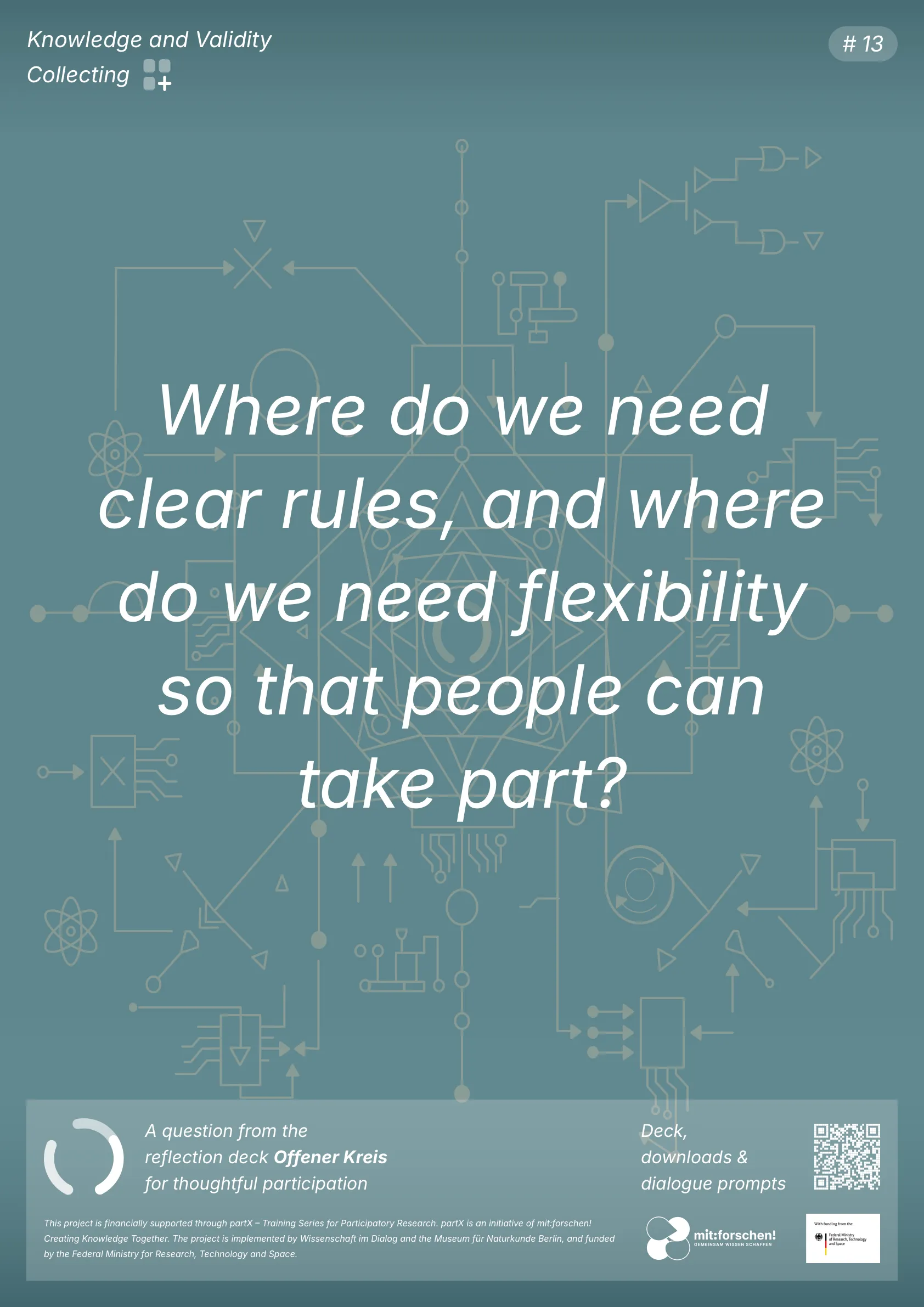
Together select 3–4 cards from the set that currently create tension in the project (e.g. #1 “When does engagement stop feeling like co-research and start feeling like compensating for missing resources?”, #13 “Where do we need clear rules and where more room to manoeuvre, so people can participate?”). Clarify fishbowl rules: Inside speaks, outside only listens. One empty chair inside is for spontaneous contributions from the outer circle.
First fishbowl round (25 min.)
Core team (e.g., project management, coordination) sits inside, discusses the selected questions. Outer circle observes: Who speaks how long? Which questions are avoided? What is treated as "given"?
Silent reflection (10 min.)
Everyone notes for themselves: What did I hear/not hear? What surprised, irritated, confirmed me?
Second fishbowl round with switch (25 min.)
Inner and outer circle partially swap. New constellation discusses the same cards. How does the dynamic change?
Evaluation in plenary (20 min.)
What became visible? Which power relations showed themselves? Where must we speak differently, decide differently in the project? No solutions, just naming.
Outcome
Collective awareness of implicit hierarchies and speaking spaces. Foundation for more conscious participation architectures in the project.
POSTERS / DOWNLOADS
Bringing questions into shared spaces
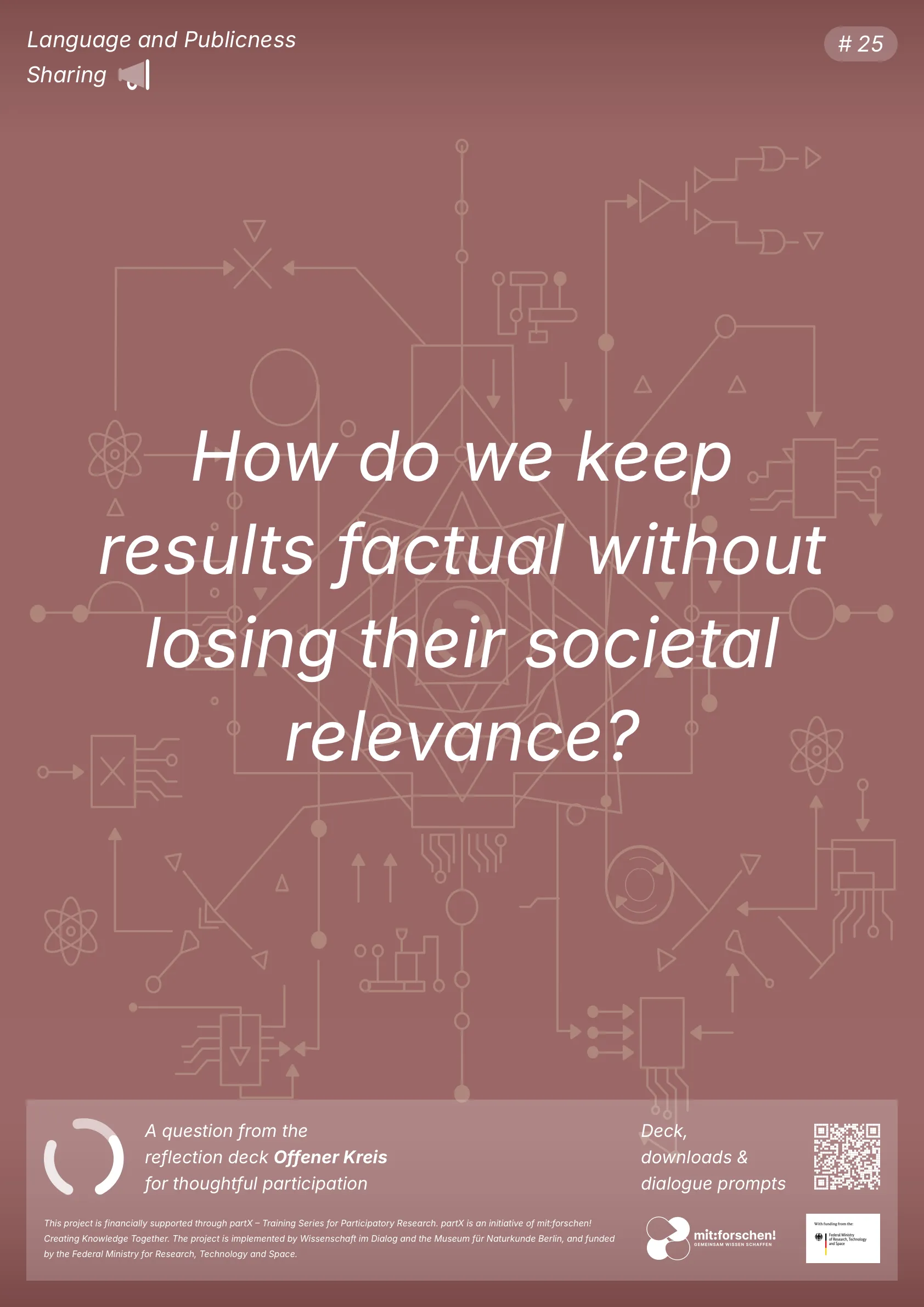
Selected questions from the deck are also available as posters for offices, hallways, seminar rooms and shared work environments.
They are not meant as campaigns, but as quiet prompts within everyday collaboration.
The first five motifs are available as direct downloads. Any of the 30 questions can also be turned into a custom poster on request.
Selected poster
Poster 01
All motifs
Further development
Feedback for the next edition
If you have used the deck or are about to, short feedback helps shape a more focused next version.
Context
Background
Concept & Editorial: Jan Meischner
Funded by: The development of this project is financially supported through partX – a training program for participatory research. partX is an initiative by mit:forschen! Gemeinsam Wissen schaffen. The program is implemented by Wissenschaft im Dialog and the Museum für Naturkunde Berlin, and funded by the Federal Ministry of Research, Technology and Space (Germany)
Developed in dialogue with: Oihana Olhasque (English review and feedback), Daniel Marks (visual system and editorial design), Stefanie Pietsch (early conceptual development of the project phases), as well as Prof. Stefan Lüdtke and Prof. Stefan Oehmcke, whose trust, institutional support, and the opportunity to join partX created the space for this work to emerge.
.png)
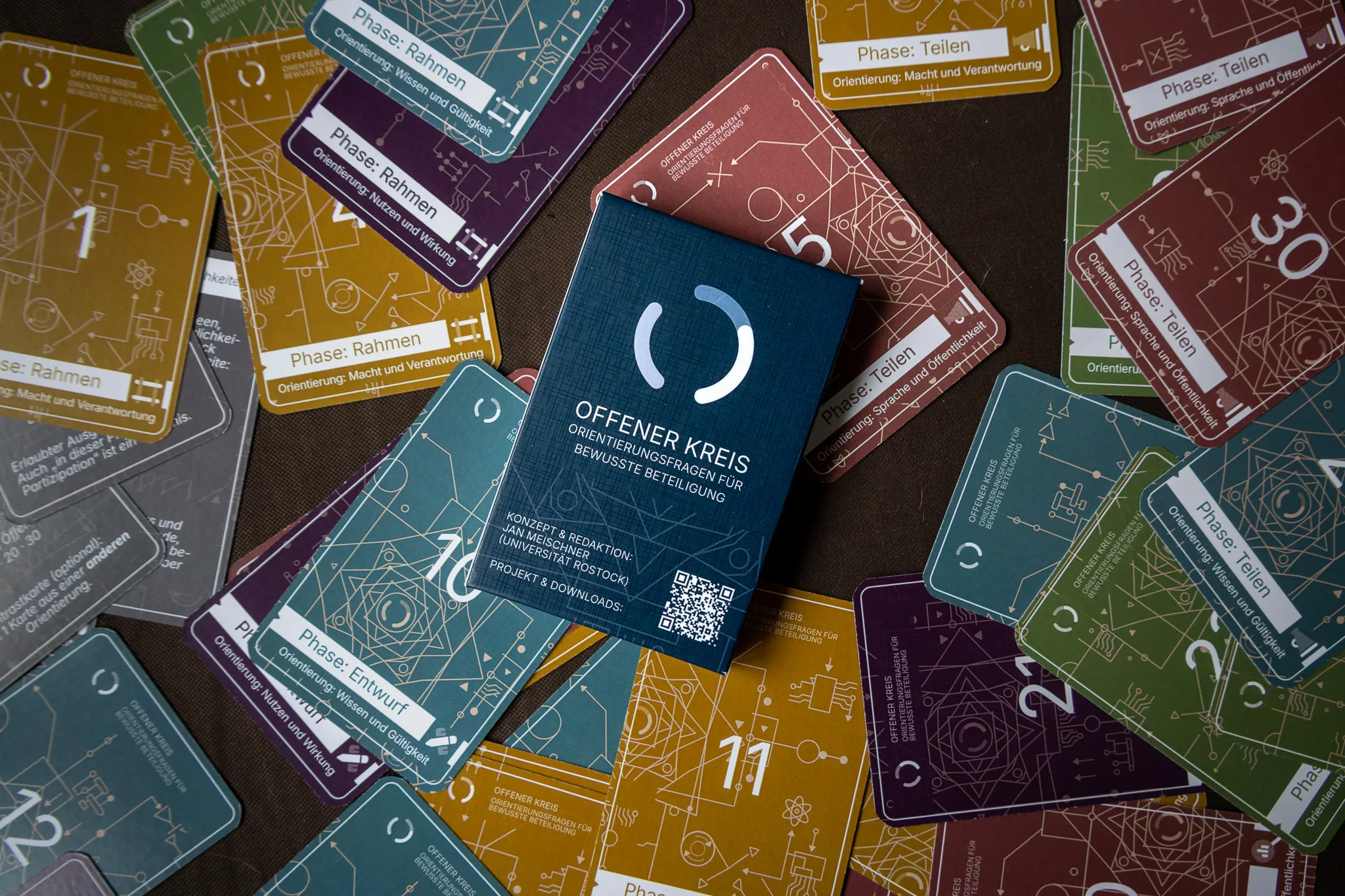
Photo: Jan Meischner
Next step
Questions, Downloads & Order
For questions, use cases, or materials related to Offener Kreis, this is the next place to continue.