A first step into entrepreneurship
A spontaneous idea, a startup competition, and a first glimpse into how research-based entrepreneurship actually works.
Four weeks ago, entrepreneurship still felt like something rather abstract to me.
I knew that funding programmes such as EXIST existed somewhere in the background, and that startup competitions were something people participated in. But they always seemed to belong to a different world - one adjacent to research, yet somehow separate from my everyday work.
That changed rather quickly.
Towards the end of May, I had the initial idea for Lantern: an AI-supported learning companion that makes scientific knowledge easier to access through spoken conversations.
Almost on a whim, I decided to submit a short project sketch to the inspired startup competition at the University of Rostock.
I did not expect much to come from it.
A few days later, I received an invitation to the final.
Building a pitch
Between my regular work, I spent several focused days preparing a ten-minute pitch.
Thinking about users was not entirely new to me. My previous work in software development had already taught me to approach problems from that perspective. What felt different this time was the stronger emphasis on the business itself. The questions were no longer only whether the idea was useful or technically feasible, but also whether it could become something sustainable, who would benefit enough to pay for it, and why someone should invest time or money in making it happen.
It was a perspective I had rarely explored before, and one that I found surprisingly interesting.
Competition day
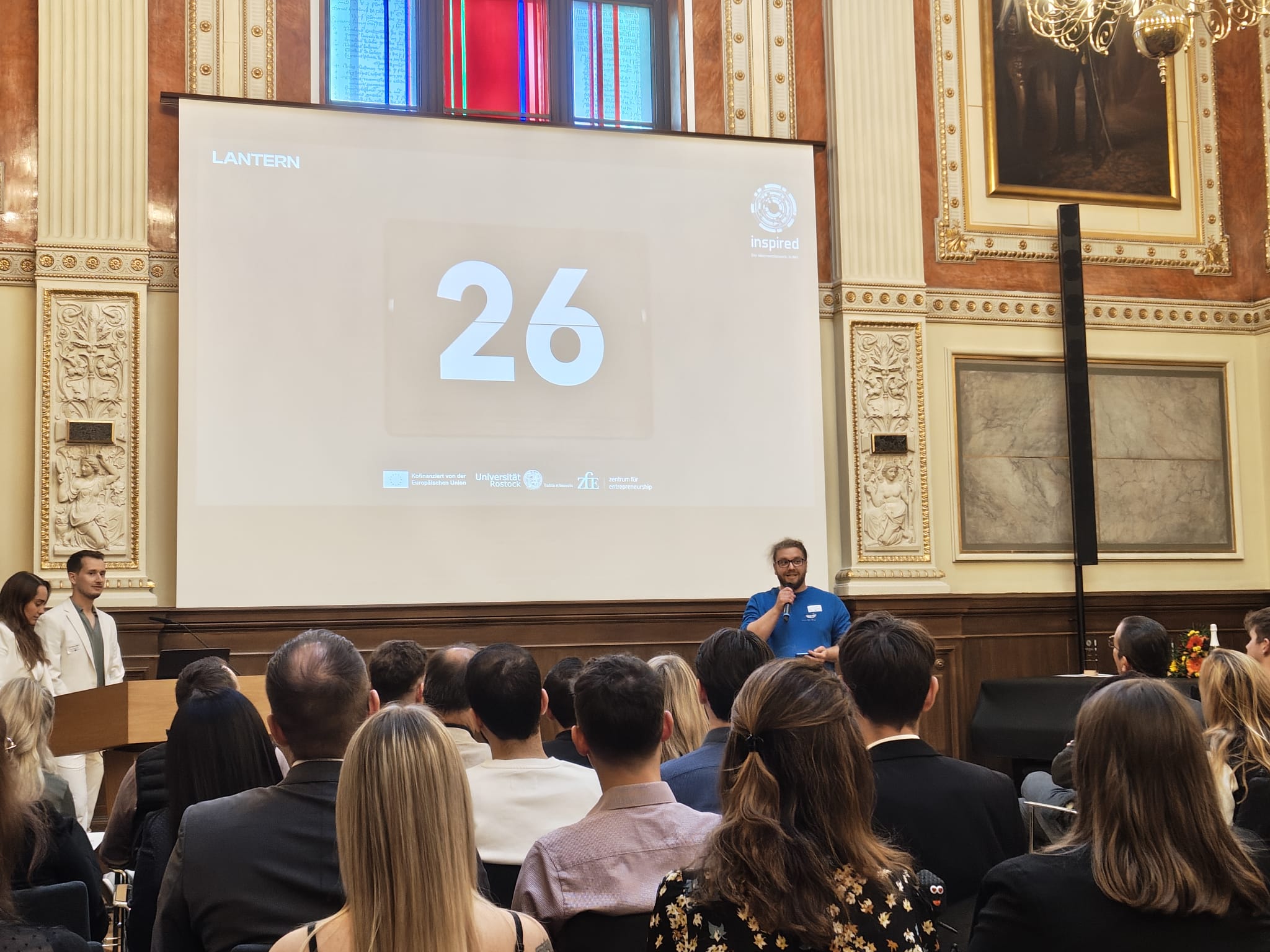
The final itself passed remarkably quickly.
After presenting Lantern around lunchtime, there were several hours before the closing ceremony, where the winners of the two competition categories were announced.
Lantern was not among the winning projects. Looking back, however, that feels almost secondary.
What I actually took away
The competition gave me something I had not really expected. For the first time, entrepreneurship stopped being an abstract concept. I learned that there are dedicated funding instruments for research-based startups, such as the EXIST programme, and that there are people whose job it is to help researchers develop early-stage ideas into viable projects.
Until then, these opportunities had always felt distant. Now they feel tangible.
Just as importantly, I gained experience creating and presenting a startup pitch. Standing in front of a jury whose role is to evaluate ideas from an entrepreneurial rather than a scientific perspective required a different way of thinking than I am used to.
Whether that skill will become useful again remains to be seen, but I am glad to have experienced it.
Looking ahead
From the first idea to standing on stage, the whole experience occupied only a small window of time. Yet it stayed on my mind far longer than those few weeks.
Lantern may or may not develop into something larger in the future. Either way, I am grateful that this small project gave me an opportunity to explore a world that had previously seemed distant.
It made entrepreneurship feel considerably less abstract than it had before.
You might also find these interesting
After months of design, printing, prototyping, and website development, Offener Kreis has become a physical card set. A short reflection on moving from creation to real-world use.
Building the workflow before the system: how I structured the early development of PelAtlas so that the next step is always visible.
Reflections on co-productive work between industry and research, and on how shared artifacts can create connection beyond formal collaboration.
Occasional updates
If this kind of work interests you
I send occasional updates when projects reach meaningful milestones, something is released, or collaboration opportunities arise.
Note on authorship: This text was developed with the support of AI tools, used for drafting and refinement. Responsibility for content, structure, and conclusions remains with the author.